Powered By Blogger

Touristic Sites In Jordan

Amman is the capital of the Hashemite Kingdom Of Jordan Near Amman (AlSalt,Wadi Seer) 1-- North and West of Amman(Jerash,‘Ajloun,Irbid,Umm Qais,Hemma,Umm al-Jimal) The Jordan Valley(The River Jordan,The Dead Sea,Deir Ain Abata Deir ‘Alla,Tabaqat Fahl) 2-- East of Amman: The Desert Castle Loop(Qasr al-Hallabat,Azraq Oasis,Qasr al-Azraq,Shomari Wildlife Reserve ,Qusayr ‘Amra,Qasr al-Harraneh,Qasr al-Mushatta Qastal) 3-- South of Amman(The King’sHighway,Madaba,MountNebo, Mkawer,Hammamat Ma’een,Karak,Khirbet al-Tannur,Tafileh ,Shobak,Dana Nature Reserve Wadi Rum) 4-- Petra 5-- Aqaba 6-- The Ancient Holy Land 7-- Islamic Holy Sites in Jordan
Showing posts with label Ammon. Show all posts

Wednesday, March 6, 2013

Amman, the capital of the Hashemite Kingdom of Jordan

Amman


Jordan's modern capital, Amman is steeped in biblical history known as the capital of the Ammonites as Rabbath Ammon, and as Philadelphia in the Roman rule, it became the southern Greco-Roman city of the Decapolis. A Roman amphitheater with capacity of 8000 spectator's .The citadel which still standing with its columns & numerous Roman-Byzantine & Islamic remains. Excavations showed that Amman goes back 9,000 years from Neolithic - Roman- Greco - Byzantine to Islamic .Remains of churches & Umayyad Palace, The Archaeological museum with some of Dead Sea scrolls & Islamic treasures and the Popular Traditions museum.


Friday, March 16, 2012

Umm al-Jimal, Jordan

Shutter Sockets


Three-Story Byzantine Tower 
Barracks ("Later Castellum") 
Umm al-Jimal, Jordan


The circular holes in the lintel are shutter sockets. The thin slots in the window frame are for inserting a metal grid, to help secure the tower while still admitting light and air.

Byzantine Tower

Byzantine Tower (c. 600 AD)


Barracks ("Later Castellum") 
Umm al-Jimal, Jordan


The three-story tower is provided with three ground-level entrances . An external staircase, photo left, ascends to a projecting platform that gives access to the second level entrance. 

Barracks ("Later Castellum")

Barracks ("Later Castellum")

Umm al-Jimal, Jordan


The provincial town of Umm al-Jimal, 50km northeast of Amman, was garrisoned by Roman soldiers from about 200 AD onward. This triggered an expansion of trade and commerce, until by 500 AD the town could boast a population of three or four thousand people. The precincts were gradually abandoned following the 7th century Arab conquest and 8th century earthquakes, although they were briefly re-occupied by the French Army in the 1920s, and by the Druze in the 1930s.

This view from the east shows the Roman fort, dated 412/413, that was built in the south end of town (not to be confused with an earlier castellum in the northeast part of town). The fort was constructed, like the rest of the town, from the abundant local stone of black basalt. It consists of a wall surrounding an inner courtyard (the barracks rooms were built on the inside of the wall), and two later Byzantine towers that were added around 600 AD. The first tower is seen to the left in this photo.

Tuesday, March 13, 2012

Olive Press

Olive Press

Qasr al-Abd, Jordan


This olive press is a tangible reminder of the economic basis of any great estate, which was required to be largely self-sufficient and contribute to the wealth of the owner. 

Lioness with Cub

Lioness with Cub

West Upper Facade (NW corner), Qasr al-Abd, Jordan


The corners of the upper facade are decorated with relief carvings of lionesses suckling their cubs, such as the one seen here. 

Entrance

Entrance

North Side, Qasr al-Abd, Jordan


The entrance to the building is a small courtyard fronted by two columns. Two additional columns, engaged on either side, complete the entrance facade. A mirror-image facade on the south side was added for reasons of symmetry, but did not serve as an entrance. 

Leopard Fountain

Leopard Fountain

East Wall, Qasr al-Abd, Jordan
 

At the base of each long wall is a fountain, carved in the shape of a leopard with raised paw. The mottling of the stone seems to mimic the leopard's spotted coat, although this may be an artifact of repair. 

East Wall

East Wall

Qasr al-Abd, Jordan


Qasr al-Abd is a rare example of Hellenistic building in the Transjordan. Perhaps intended as a pleasure palace, it was erected about 200 BC by a Tobiad notable, Hyrcanus of Jerusalem, as part of a much larger estate that is now covered by the village of Iraq al-Emir. The Qasr was originally surrounded by a large excavated reflecting pool (or moat, according to the 1st century AD Jewish historian Josephus, who considered the Qasr to be a fortress; its tentative identification as a pleasure palace is due to the contemporary Israeli archaeologist, Ehud Netzer.)

Hyrcanus took his own life in 175 BC, having come out on the wrong side of the conflict between Ptolemies and Seleucids for control of the area. The Qasr was unfinished at his death, as indicated by several incomplete carvings and columns on site. The building has two storys, and is about 125 feet long, 62 feet wide, and 40 feet high. It is located 17km (10mi) west of Amman.

Wednesday, March 7, 2012

Roman Theatre

Roman Theatre

Amman, Jordan
Here is a precipitous view of nearly the whole theatre, as seen from close to the top. The highest section of seats in a theatre was (and still is) called "The Gods," for reasons evident here. Although far from the stage, even here the sightlines are excellent, and the actors could be clearly heard, owing to the steepness of the cavea.

Sunday, March 4, 2012

Dome of the Vestibule

Dome of the Vestibule

Citadel, Amman, Jordan
The interior of the dome of the Umayyad vestibule is shown here. This is a modern recreation; the original dome's interior would have been painted and plastered, giving a much different appearance.

Cistern


Cistern

Citadel, Amman, Jordan
This large cistern, located to the right of the vestibule, was the primary water supply to the governor's palace. At 5m deep and 16m in diameter, it would have held just over 1,000 cubic meters, or approximately 250,000 gallons, of water. The cistern was fed by rainwater through an inlet channel, and could be entered for maintenance by the stairs shown in the photo. A column, whose stump is standing at the bottom of the cistern, measured the water level.

Umayyad Mosque

Umayyad Mosque

Citadel, Amman, Jordan

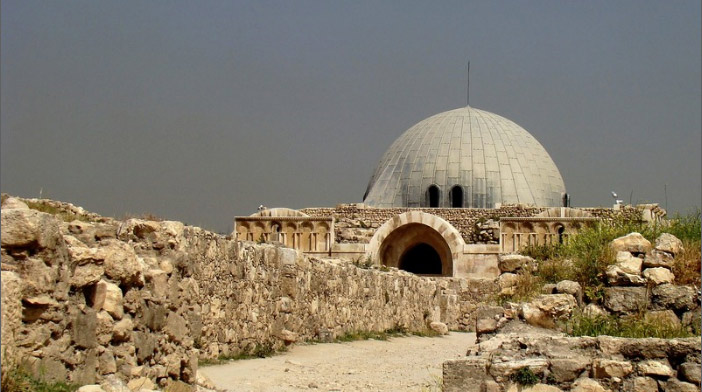
This view looking north shows the domed entrance (vestibule) to the Umayyad governor's palace (8th century) in the background. The dome is a modern reconstruction that gives the building an odd, Pac-Man-like appearance. The entrance to the vestibule is the large semicircular archway below the dome. In the foreground are the remains of the palace mosque, whose column bases surround an open courtyard. A short section of the mosque's wall has been reerected here.

The photo makes it clear that the axis of the vestibule is not aligned with the axis of the mosque, which nominally points in the direction of Mecca. There doesn't seem to be any obvious reason why the vestibule could not have been lined up with the mosque, although I suppose there is no architectural rule that would have required it to do so.

Byzantine Church

Byzantine Church

Citadel, Amman, Jordan
The Byzantine basilica was constructed in the 5th-6th centuries AD. Its nave is flanked by two rows of columns. The photo looks eastwards from the entrance down the length of the nave, towards the partially reconstructed semicircular wall of the apse.

Temple of Hercules

Temple of Hercules

Citadel, Amman, Jordan
The temple, described on the previous page, is viewed here from the rear (northwest corner). The temple itself is 31m long by 26m wide; its outer temenos (sacred precinct) measures 122x72 meters.

Temple of Hercules

Temple of Hercules

Citadel, Amman, Jordan
The great temple of Hercules (Herakles) was built between 162-166 AD. Larger than any temple in Rome itself, the massive structure faces east and is seen here from the front (northeast corner.) The temple portico is framed by six 33-foot tall columns. The absence of columns on the rest of the structure, has convinced the excavator that the temple was actually left unfinished. A model of the temple is displayed at ACOR, the American Center for Oriental Research in Amman.

the Citadel (Jabal al-Qal'a) in the middle of Amman


The Hill of the Citadel (Jabal al-Qal'a) in the middle of Amman was occupied as early as the Neolithic period, and fortified during the Bronze Age (1800 BC). The ruins on the hill today are Roman through early Islamic. The name "Amman" comes from "Rabbath Ammon," or "Great City of the Ammonites," who settled in the region some time after 1200 BC. The Bible records that King David captured the city in the early 10th century BC; Uriah the Hittite, husband of King David's paramour Bathsheba, was killed here after the king ordered him to the front line of battle.

In ancient times, Amman with its surrounding region was successively ruled by the then-superpowers of the Middle East: Assyria (8th century BC), Babylonia (6th century), the Ptolemies, the Seleucids (third century BC), Rome (1st century BC), and the Umayyads (7th century AD). Renamed "Philadelphia" after himself by Ptolemy II Philadelphus, the city was incorporated into Pompey the Great's province of Syria, and later into the province of Arabia created by Trajan (106 AD). As the southernmost city of the Decapolis, Philadelphia prospered during Imperial times due to its advantageous location alongside Trajan's new trade and administrative road, the Via Nova Traiana.

When Transjordan passed into Arab rule in the 7th century AD, its Umayyad rulers restored the city's original name of Amman. Neglected under the Abbasids and abandoned by the Mamlukes, the city's fortunes did not revive until the late 19th century, under the Ottoman empire. Amman became the capital of the Emirate of Transjordan in 1921, and of the newly-created Hashemite Kingdom of Jordan in 1947. Greater Amman (the core city plus suburbs) today remains by far the most important urban area in Jordan, containing over half of the country's population or about 3 million out of 5 million people.

Wednesday, February 29, 2012

The Old Testament Kingdoms of Jordan

The Old Testament Kingdoms of Jordan

The Iron Age (c. 1200-332 BCE) saw the development and consolidation of three new kingdoms in JordanEdom in the south,Moab in central Jordan, and Ammon in the northern mountain areas. To the north in Syria, the Aramaeans made their capital in Damascus. This period saw a shift in the level of power from individual “city-states” to larger kingdoms. One possible reason for the growth of these local kingdoms was the growing importance of the trade route from Arabia, which carried gold, spices and precious metals through Amman and Damascus up to northern Syria.

Double faced female head, Middle Bronze Age. © Ministry of Tourism & Antiquities

The bulk of the Biblical Old Testament took place during this period. There is little archeological evidence to fully support the Biblical account of the Israelites’ occupation of Palestine. Although archaeologists have demonstrated that certain cities supposedly taken by the Israelites were indeed destroyed during this period, it is equally feasible that they may have been sacked by invading Egyptian armies. It is probable that the “conquest” occurred more gradually than in the Biblical narrative, with the process more akin to waves of ethnic migration than a conventional military campaign.

Pilgrim flask, Iron Age, Madaba.© Ministry of Tourism & Antiquities

According to the Biblical account of the Exodus from Egypt (c. 1270-1240 BCE), the Israelites requested permission to pass unharmed through the Kingdom of Edom. After having been denied permission, they skirted Edom to the east and continued north until they reached the borders of the Amorite country near Madaba. Not trusting the Israelites’ intentions, and not wishing to place the added strain of thousands of migrants upon his food and water stores, the Amorite leader Sihon refused them passage as well. This time, 
the Israelites fought back and defeated Sihon, occupying his territory

According to the Bible, the Israelites then continued their northward trek into the Kingdom of Moab, where the Moabite king set up an alliance between the five tribal kings of Midian (the Hijaz of Arabia). The increasingly powerful Israelites triumphed over the Midianites as well, and some of the tribes settled in the conquered territories. The prophet Moses apparently climbed, or was carried, to the top of Mount Nebo, where, according to some sources, he died. Joshua then led the remaining tribes across the Jordan River into Palestine. A united Kingdom of Israel arose there about 1000 BCE with Saul and David as its first kings. After the death of David’s son King Solomon in 922 BCE, the kingdom divided into two, with Israel in the 
north and Judah in the south.

The relative ease with which the Israelites made their way north and west into Palestine says much about the situation in Egypt, which still nominally ruled the lands of Jordan and Palestine. Attacks from the “Sea Peoples” of the Mediterranean Sea had weakened the Pharaonic empire and allowed the Philistines to gain a foothold on Egyptian soil as well as in Palestine and Jordan. The primary contribution of the Philistines to local culture was the introduction of iron working to the region. Their superior skills in weapon-making gave them a military advantage and assisted in their early victories over the Israelite tribes. By around 1000 BCE, however, iron was in widespread use throughout the region.

In general, trouble for the Israelites was good news for the kingdoms of Jordan. The split into Israel and Judah in 922 BCE, combined with the invasion of the Egyptian Shishak against Israel four years later, allowed the three kingdoms a bit of breathing room and prosperity. After the death of King David around 960 BCE, Edom regained most of its former independence. The Edomites occupied southern Jordan and their capital at Buseira possessed at least one large temple or palace. They were skilled in copper mining and smelting, and had settlements near modern-day Petra and Aqaba.

The Moabites are best known from the Mesha Stele, a ninth-century BCE stone which extols the deeds of the Moabite King Mesha. He won a victory over the occupying Israelites, who were still clearly a major thorn in the side of the Moabites. The Kingdom of Moab covered the center of Jordan, and its capital cities were at Karak and Dhiban. The Kingdom of Ammon around 950 BCE displayed rising prosperity based on agriculture and trade, as well as an organized defense policy with a series of fortresses. Its capital was in the Citadel of present-day Amman. 

The wealth of these kingdoms made them targets for raids or even conquest by the neighboring Israelites, the Aramaeans in Damascus, and the Assyrians with their capital at Ashur in northern Mesopotamia (modern-day Iraq). From the ninth century BCE on, the Assyrians campaigned against the Aramaeans, and in the late eighth century BCE they captured Damascus as well as Samaria, the capital of the northern kingdom of Israel. The kingdoms of Ammon, Moab and Edom retained their independence, however, by buying the Assyrians off with tribute.

The Assyrian Empire came crashing down in 612 BCE, when Nineveh fell to an alliance of Medes of Persia and the Chaldean kings of Babylonia. In its place arose the Babylonian Empire and King Nebuchadnezzar, whose defeat of the Egyptians at Carchemish in 605 BCE threw much of the region into turmoil. Considerable population shifts took place under the Babylonians, exemplified by the Edomites’ migration from Jordan into the area in southern Palestine known as Idumaea. In fact, there was a decline in urban development and power swung back again to nomadic tribes. In 587 BCE, Nebuchadnezzar II of Babylon destroyed Jerusalem and deported thousands of Jews to Babylonia.

In 539 BCE, the Persians under Cyrus II ended the disruptive rule of the Babylonian Empire and paved the way for a period of more organized life and prosperity. The Persian Empire became the largest yet known in the Near East, and Cyrus’ successors conquered Egypt, northern India, Asia Minor, and frequently conflicted with the Greek states of Sparta and Athens. Internal turmoil continued in Jordan, with numerous clashes occurring between the Moabites and Ammonites.

Jordan and Palestine were placed under the control of a Persian viceroy with subordinate governors. Meanwhile, Cyrus freed the Jews from captivity in Babylonia and allowed them to rebuild the temple in Jerusalem. The Moabites and Ammonites interpreted this as a virtual declaration of sovereignty, and hence organized attacks upon the resettled Jews. They were led in this campaign by Tobiah, whom the Persians had appointed as governor. Tobiah set up a short-lived local dynasty, but ultimately the Persian leader Darius I (522-486 BCE) safeguarded the Jewish community and the temple was rebuilt.

After establishing the greatest empire yet known in the Near East, economic decline, revolts, murders and palace conspiracies weakened the Persian throne. In 332 BCE, Alexander the Great conquered the Persian capital of Persepolis (in modern Iran) and established Greek control over Jordan and surrounding countries.