Powered By Blogger

Touristic Sites In Jordan

Amman is the capital of the Hashemite Kingdom Of Jordan Near Amman (AlSalt,Wadi Seer) 1-- North and West of Amman(Jerash,‘Ajloun,Irbid,Umm Qais,Hemma,Umm al-Jimal) The Jordan Valley(The River Jordan,The Dead Sea,Deir Ain Abata Deir ‘Alla,Tabaqat Fahl) 2-- East of Amman: The Desert Castle Loop(Qasr al-Hallabat,Azraq Oasis,Qasr al-Azraq,Shomari Wildlife Reserve ,Qusayr ‘Amra,Qasr al-Harraneh,Qasr al-Mushatta Qastal) 3-- South of Amman(The King’sHighway,Madaba,MountNebo, Mkawer,Hammamat Ma’een,Karak,Khirbet al-Tannur,Tafileh ,Shobak,Dana Nature Reserve Wadi Rum) 4-- Petra 5-- Aqaba 6-- The Ancient Holy Land 7-- Islamic Holy Sites in Jordan
Showing posts with label Shobak. Show all posts

Monday, February 27, 2012

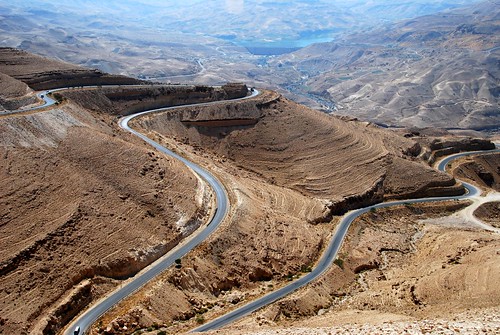
The King’s Highway

South of Amman


There are two routes connecting Amman with the south of Jordan: the Desert Highway and the King’s Highway. If your time is limited, use the straighter and faster Desert Highway. However, by far the more interesting route is the King’s Highway, which twists and winds its way through the heart of Jordan, connecting Madaba, Karak, Tafileh, Shobak and Petra. The King’s Highway is the world’s oldest continuously used communication route, and is mentioned early in the Bible. In Numbers 20, Moses requests the king of Edom to allow his people to "travel along the king’s highway and not turn to the right or to the left until we have passed through your territory."


Friday, February 17, 2012

Shobak Castle(Crusader castle)

Shobak Castle(Crusader castle)


Shobak Castle is an early 12th-century Crusader castle in barren surroundings. It is perched on the side of a rocky, conical mountain at 1,300m (4,265ft) above sea level, looking out over fruit trees below. Although not so well-preserved or visited as Kerak Castle, its isolation from the nearest town makes it more atmospheric.

History


Shobak was originally called Krak de Montreal or Mons Regalis. Built in 1115, it was the first of many fortifications built beyond the Jordan by King Baldwin I of Jerusalem to guard the road from Egypt to Damascus. It successfully resisted a number of sieges until it fell to Saladin's troops in 1189.
What to See

Much of what remains of Shobak Castle today are reconstructions and additions from the Mamluk period, but there are numerous original Crusader features as well. The northeast corner of the castle has a keep with Quaranic inscriptions in Kufic script, possibly dating to the time of Saladin. There aretwo churches in Shobak Castle. The first one, near the entrance, and has an apse, two smaller niches, and a baptistery off the west side. The second church is near the southeast corner of the castle (next to a Mamluk watchtower with more Kufic script), with a Crusader cross carved in the east wall. Beneath the church are catacombs, which contain Islamic tablets, Christian carvings, big round rocks used in catapults, and what is claimed to be Saladin's throne.

Quick Facts


Names:
Shobak Castle:  Montreal; Mons Regalis;
Type of site:       Crusader castle
Status:                Ruins
Date:                  1115
Architecture:      Crusader Romanesque
Hours:                Daylight hours
Cost:                  Free
Tip:                     Bring a flashlight for exploring the many dark corners

Thursday, February 16, 2012

Shobak (Shobek) - Crusader castle


Shobak (Shobek) - Crusader castleis an early 12th-century Crusader castle in barren surroundings. It is perched on the side of a rocky, conical mountain at 1,300m (4,265ft) above sea level, looking out over fruit trees below
Shobak Castle; Montreal; Mons Regalis;

Much of what remains of Shobak Castle today are reconstructions and additions from the Mamluk period, but there are numerous original Crusader features as well. The northeast corner of the castle has a keep with Quaranic inscriptions in Kufic script, possibly dating to the time of Saladin. There are two churches in Shobak Castle. The first one, near the entrance, and has an apse, two smaller niches, and a baptistery off the west side. The second church is near the southeast corner of the castle (next to a Mamluk watchtower with more Kufic script), with a Crusader cross carved in the east wall. Beneath the church are catacombs, which contain Islamic tablets, Christian carvings, big round rocks used in catapults, and what is claimed to be Saladin's throne.

Shobak Castle

The castle's exterior is impressive


The castle's exterior is impressive, with a forbidding gate and encircling walls three layers thick. The walls and projecting towers are still reasonably intact, but inside the castle consists mainly of tumbled stones with a few walls and arches. One of the most fascinating remains is the ancient well-shaft cut deep into the rock, with 375 steps leading down to the water supply at the bottom.

arches

 kings highway below

Shobak Castle(Crusader castle)

Shobak Castle(Crusader castle)


Shobak, Jordan
Just off the King's Highway 190 km south of Amman and less than an hour north of Petra stands an impressive castle as a lonely reminder of former Crusader glory dating from the same turbulent period as Kerak, crowning a cone of rock, which rises above a wild and rugged landscape dotted with a grand sweep of fruit trees below.
t is today known as Shobak, but to the Crusaders it was Mont Real (Crak de Montreal) or Mons Regalis, the Fortress of the Royal Mount. It was built in 1115 by King Baldwin I of Jerusalem to guard the road from Damascus to Egypt, and was the first of a string of similar strongholds in the Latin Kingdom of Jerusalem.


Salahuddin Al-Ayyoubi (Saladin) attacked it on several occasions, finally capturing it in 1189 (only 75 years after it was raised) when the Crusaders were losing their foothold throughout the Holy Land. Inscriptions by Saladin's proud successors appear on the castle wall. In 1260, it passed to the Mamluks whom restored it in the following century, adorning its walls and towers with Arabic inscriptions which testify to their work. Since then it has lain largely untouched, gradually falling into greater disrepair.

Shobak Castle(Crusader castle)


Shobak, Shobak


Shobak Castle(Crusader castle)


Shobak (Shobek) - Crusader castle

Shobak Castle(Crusader castle)


Crusader Castle
Shobak, Jordan


Shobek is the earliest Crusader castle in Jordan. Built in 1115 by Baldwin I, it was only surrendered in 1189, two years after the Battle of Hattin. The strength of this fortress was, in a sense, its weakness; cut off and surrounded, its garrison nevertheless held fast, amid incredible privation and suffering, long after any rational hope of relief had vanished.

Shobek is located on Mont Rial, about 23 km north of Petra. Rebuilt several times, its walls and towers, as seen today, date to the Islamic period, 13th century and later.

Shobak Castle(Crusader castle)


Shobak (Shobek) - Crusader castleis an early 12th-century Crusader castle in barren surroundings. It is perched on the side of a rocky, conical mountain at 1,300m (4,265ft) above sea level, looking out over fruit trees below
Shobak Castle; Montreal; Mons Regalis;

Much of what remains of Shobak Castle today are reconstructions and additions from the Mamluk period, but there are numerous original Crusader features as well. The northeast corner of the castle has a keep with Quaranic inscriptions in Kufic script, possibly dating to the time of Saladin. There are two churches in Shobak Castle. The first one, near the entrance, and has an apse, two smaller niches, and a baptistery off the west side. The second church is near the southeast corner of the castle (next to a Mamluk watchtower with more Kufic script), with a Crusader cross carved in the east wall. Beneath the church are catacombs, which contain Islamic tablets, Christian carvings, big round rocks used in catapults, and what is claimed to be Saladin's throne.

Shobak Castle(Crusader castle)


Shobak Castle
This is yet another castle in the great chain of Crusader fortresses which stretches across Jordan. The stronghold, known as Mont Realis (Montreal), was constructed in 1115 CE by Baldwin I. At its height Shobak was home to about 6000 Christians. It suffered numerous assaults by Salah Eddin (Saladin) before it finally fell to him in 1189. Shobak Castle was then restored by the Mamluks in the 14th century.
The castle is perched on top of a small hill northeast of the town of Shobak. Inside the fortress there are two churches, the first of which is to the left of the entrance and up the stairs. There are ruins of baths, cisterns and rainwater pipes, in addition to millstones for pressing olives, a few archways and other works which have stood the test of time. The caretaker can point out a shaft from which a set of stairs cut into the rock leads down to a spring below the castle. The shaft has 375 steps and is one of the deepest wells ever cut by Crusader forces.

A side road leads to the castle from the King’s Highway about two kilometers north of Shobak village. From there it is another four kilometers to the castle.
 — مع Shobak Castle‏.

Shobak Castle(Crusader castle)


Shobak Castle(Crusader castle)


Shobak Castle(Crusader castle)


Shobak Castle was the first Crusader castle in Jordan


Shobak Castle was the first Crusader castle in Jordan