Powered By Blogger

Touristic Sites In Jordan

Amman is the capital of the Hashemite Kingdom Of Jordan Near Amman (AlSalt,Wadi Seer) 1-- North and West of Amman(Jerash,‘Ajloun,Irbid,Umm Qais,Hemma,Umm al-Jimal) The Jordan Valley(The River Jordan,The Dead Sea,Deir Ain Abata Deir ‘Alla,Tabaqat Fahl) 2-- East of Amman: The Desert Castle Loop(Qasr al-Hallabat,Azraq Oasis,Qasr al-Azraq,Shomari Wildlife Reserve ,Qusayr ‘Amra,Qasr al-Harraneh,Qasr al-Mushatta Qastal) 3-- South of Amman(The King’sHighway,Madaba,MountNebo, Mkawer,Hammamat Ma’een,Karak,Khirbet al-Tannur,Tafileh ,Shobak,Dana Nature Reserve Wadi Rum) 4-- Petra 5-- Aqaba 6-- The Ancient Holy Land 7-- Islamic Holy Sites in Jordan
Showing posts with label Geography. Show all posts

Sunday, March 4, 2012

Geography, Birdlife & Marine Life


 Birdlife
Spur-winged Plovers in Safi© Jad Al Younis, Discovery Eco-Tourism
Jordan also possesses a large and varied assortment of birdlife. This can be traced, once again, to the variety of habitats found within the country–from mountains forests to desert oases, from high cliffs to sweeping deserts, and from deep gorges to broadwadis. Two distinct types of avifauna can be found in Jordan: those species which stay year-round, and migratory visitors.

At the junction of the Mediterranean and Arabian faunal regions, Jordan lies on one of the world’s major bird migration routes, between Africa and Eurasia. Before the water levels of the Azraq Reserve were depleted over the past ten years, up to 200,000 birds–including spoonbills, white pelicans, egrets, terns and gulls, to name a few–would congregate there at one time during the migratory season. The numbers of migrants have decreased as Azraq has grown drier, yet even today up to 220 migratory species continue to transit through Jordan on their journey north or south. The approximately 150 species which are indigenous to Jordan seem not to have been affected greatly by the great drought of the 1980s.


 Marine Life
The Gulf of Aqaba is home to some of the finest marine life in the Middle East, while its coral reefs are unmatched in the world. The gulf is very narrow–at its northern end it is only five kilometers wide–and quite deep, ranging in depth from between 1000 to 1800 meters. The depth of the gulf, combined with its isolation from sea currents, minimize turbulence and improve visibility. On the sandy shores, one can find creatures such as the ghost crab, sandhoppers and the mole crab.
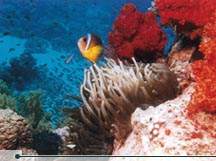
Gulf of Aqaba

The sea waters, meanwhile, host a plethora of marine life including starfish, sea cucumbers, crabs, shrimps, sea urchins, many species of fish and several worms which burrow into the sandy sea bottom. A variety of sea grasses can be found in the shallow waters, providing both food and shelter to the fishes which inhabit the area. Several species of eel make their home in the gulf’s grass beds, where one can also find sea horses and pipe fishes.
Marine meadow beneath the surface of the Gulf of Aqaba© Camerapix 1994
Perhaps the greatest attraction for divers in the Gulf of Aqaba is the colorful coral reefs, found especially near the southern part of Jordan’s coastline. There are around 100 varieties of stony coral, and they are found mainly in shallow waters, as the algae that live within them require light for photosynthesis. Many hundreds of fish species make their homes among the reefs, and some live by eating the algae that grows on the coral.


Geography, Fauna


Arabian Horse
One can find about 70 species and subspecies of mammals, along with 73 reptile species, in Jordan. The dry climate has limited amphibian species to only four families. About 20 species of freshwater fish are found in Jordan’s rivers and streams, while around 1000 species of fish are known to exist in the rich waters of the Gulf of Aqaba
Swallow- tail butterfly
The harsh conditions of the desert wilderness, which covers most of the country, allow only an assortment of nature’s hardiest and most adaptable creatures to survive. As with most desert habitats, the majority of faunal life consists of insects, lizards, and small mammals. However, a number of larger mammals can be found in the desert region, including the Asiatic jackal, desert fox, striped hyena, wolf, camel, rabbit and sand rat. The white oryx, which was hunted almost to extinction, lives on the open plains, while the mountain ibex is at home among rocky, mountainous crags. Both of these two species are relatively rare.

Geography,Arabian Oryx,Flora


Arabian Oryx at the Shomari Reserve.
Throughout history, the land of Jordan has been renowned for its luxurious vegetation and wildlife. Ancient mosaics and stone engravings in Jawa and Wadi Qatif show pictures of oryx, Capra ibex and oxen. Known in the Bible as the “land of milk and honey,” the area was described by more recent historians and travelers as green and rich in wildlife. During the 20th century, however, the health of Jordan’s natural habitat has declined significantly. Problems such as desertification, drought and overhunting have damaged the natural landscape and will take many years to rectify.

Fortunately, Jordanians have taken great strides in recent years toward stopping and reversing the decline of their beautiful natural heritage. Even now, the Kingdom retains a rich diversity of animal and plant life that varies between the Jordan Valley, the Mountain Heights Plateau and the Badia Desert region.

Anemonis in a thorny bush springtime in Jordan.
Spring is the high season for Jordanian flora, and from February to May many regions are carpeted with a dazzling array of flowering plants. More than 2000 species of plants grow in Jordan, and the variety of the country’s topography and climate is reflected in the diversity of its flora. Most of these species, however, depend heavily on the winter rains. When there is a warm, dry winter–as in 1984–many flowers either fail to appear or are considerably reduced.


Jordan's national flower, the Black Iris.
Jordan boasts a wide variety of flowering wild flowers, but the most famous is the national flower -the black iris. Fields of this flower, which is not found in Europe, can be seen in masses near the town of Madaba.


Ancient olive trees at the village of Tibneh near Irbid, some of which could be from Roman times. 

The highlands of Jordan host forests of oak and pine, as well as pistachio and cinnabar trees. Olive, eucalyptus and cedar trees thrive throughout the highlands and the Jordan ValleyJordan’s dry climate is especially conducive to shrub trees, which require less water. Species of shrubs can be found throughout all the geographical regions of Jordan.

Flowers.
Contrary to popular conceptions, deserts are often teaming with life. Many small shrub plants thrive in the Badia, where they are often grazed by the goats of local Bedouin tribes. Several species of acacia trees can be found in the deserts, as well as a variety of sturdy wild flowers and grasses which grow among the rocks in this demanding habitat.


Thursday, March 1, 2012

Geography


 The Eastern Desert or Badia Region
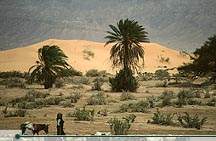
Comprising around 75% of Jordan, this area of desert and desert steppe is part of what is known as the North Arab Desert. It stretches into Syria, Iraq and Saudi Arabia, with elevations varying between 600 and 900 meters above sea level. Climate in the Badia varies widely between day and night, and between summer and winter. Daytime summer temperatures can exceed 40°C, while winter nights can be very cold, dry and windy. Rainfall is minimal throughout the year, averaging less than 50 millimeters annually. Although all the regions of the Badia (or desert) are united by their harsh desert climate,similar vegetation types and sparse concentrations of population, they vary considerably according to their underlying geology.


The volcanic formations of the northern Basalt Desert extend into Syria and Saudi Arabia, and are recognizable by the black basalt boulders which cover the landscape. East of the Basalt Desert, the Rweishid Desert is an undulating limestone plateau which extends to the Iraqi border. There is some grassland in this area, and some agriculture is practiced there. Northeast of Amman, the Eastern Desert is crossed by a multitude of vegetated wadis, and includes the Azraq Oasis and the Shomari Wildlife Reserve.

Brightly blue lizard, Petra.
© Ammar Khammash
To the south of Amman is the Central Desert, while Wadi Sarhan on Jordan’s eastern border drains north into Azraq. Al-Jafr Basin, south of the Central Desert, is crossed by a number of broad, sparsely-vegetated wadis. South of al-Jafr and east of the Rum Desert, al-Mudawwara Desert is characterized by isolated hills and low rocky mountains separated by broad, sandywadis. The most famous desert in Jordan is the Rum Desert, home of the wondrous Wadi Rum landscape. Towering sandstone mesas dominate this arid area, producing one of the most fantastic desert-scapes in the world.


Geography


 The Mountain Heights Plateau

Wadi Mujib. © Jad Al Younis, Discovery Eco-Tourism

The highlands of Jordan separate the Jordan Valley and its margins from the plains of the eastern desert. This region extends the entire length of the western part of the country, and hosts most of Jordan’s main population centers, including Amman, Zarqa, Irbid and Karak. We know that ancient peoples found the area inviting as well, since one can visit the ruins of Jerash, Karak, Madaba, Petra and other historical sites which are found in the Mountain Heights Plateau. These areas receive Jordan’s highest rainfall, and are the most richly vegetated in the country

Wadi Finan. © Jad Al Younis, Discovery Eco-Tourism

The region, which extends from Umm Qais in the north to Ras an-Naqab in the south, is intersected by a number of valleys and riverbeds known as wadis. The Arabic word wadi means a watercourse valley which may or may not flow with water after substantial rainfall. All of the wadis which intersect this plateau, including Wadi Mujib, Wadi Mousa, Wadi Hassa and Wadi Zarqa, eventually flow into the Jordan River, the Dead Sea or the usually-dry Jordan Rift. Elevation in the highlands varies considerably, from 600 meters to about 1,500 meters above sea level, with temperature and rainfall patterns varying accordingly.


The northern part of the Mountain Heights Plateau, known as the northern highlands, extends southwards from Umm Qais to just north of Amman, and displays a typical Mediterranean climate and vegetation. This region was known historically as the Land of Gilead, and is characterized by higher elevations and cooler temperatures.


South and east of the northern highlands are the northern steppes, which serve as a buffer between the highlands and the eastern desert. The area, which extends from Irbid through Mafraq and Madaba all the way south to Karak, was formerly covered in steppe vegetation. Much of this has been lost to desertification, however. In the south, the Sharra highlands extend from Shobak south to Ras an-Naqab. This high altitude plain receives little annual rainfall and is consequently lightly vegetated.

Geography


 The Jordan Valley
The Jordan Valley, which extends down the entire western flank of Jordan, is the country’s most distinctive natural feature. The Jordan Valley forms part of the Great Rift Valley of Africa, which extends down from southern Turkey through Lebanon and Syria to the salty depression of the Dead Sea, where it continues south through Aqaba and the Red Sea to eastern Africa. This fissure was created 20 million years ago by shifting tectonic plates.


The northern segment of the Jordan Valley, known in Arabic as theGhor, is the nation’s most fertile region. It contains the Jordan River and extends from the northern border down to the Dead SeaTheJordan River rises from several sources, mainly the Anti-Lebanon Mountains in Syria, and flows down into Lake Tiberias (the Sea of Galilee), 212 meters below sea level. It then drains into the Dead Sea which, at 407 meters below sea level, is the lowest point on earth. The river is between 20 and 30 meters wide near its endpoint. Its flow has been much reduced and its salinity increased because significant amounts have been diverted for irrigational uses. Several degrees warmer than the rest of the country, its year-round agricultural climate, fertile soils, higher winter rainfall and extensive summer irrigation have made the Ghor the food bowl of Jordan.

The Jordan River ends at the Dead Sea, which, at a level of over 407 meters below sea level, is the lowest place on the earth’s surface. It is landlocked and fed by the Jordan River and run-off from side wadis. With no outlet to the sea, intense evaporation concentrates its mineral salts and produces a hypersaline solution. The sea is saturated with salt and minerals–its salt content is about eight times higher than that of the world’s ocean–and earns its name by virtue of the fact that it supports no indigenous plant or animal life. The Dead Sea and the neighboring Zarqa Ma’een hot springs are famous for their therapeutic mineral waters, drawing visitors from all over the world.
 
Wadi Araba. © Zohrab
South of the Dead Sea, the Jordan Valley runs on through hot, dry Wadi ‘Araba. This spectacular valley is 155 kilometers long and is known for the sheer, barren sides of its mountains. Its primary economic contribution is through potash mining. Wadi ‘Araba rises from 300 meters below sea level at its northern end to 355 meters above sea level at Jabal Risha, and then drops down again to sea level at Aqaba.

The seaside city of Aqaba is Jordan’s only outlet to the sea. Its 40 kilometer-long coastline houses not only a tourist resort and Jordan’s only port, but also some of the finest coral reefs in the world. The rich marine life of these reefs provides excellent opportunities for snorkeling and diving.