Powered By Blogger

Touristic Sites In Jordan

Amman is the capital of the Hashemite Kingdom Of Jordan Near Amman (AlSalt,Wadi Seer) 1-- North and West of Amman(Jerash,‘Ajloun,Irbid,Umm Qais,Hemma,Umm al-Jimal) The Jordan Valley(The River Jordan,The Dead Sea,Deir Ain Abata Deir ‘Alla,Tabaqat Fahl) 2-- East of Amman: The Desert Castle Loop(Qasr al-Hallabat,Azraq Oasis,Qasr al-Azraq,Shomari Wildlife Reserve ,Qusayr ‘Amra,Qasr al-Harraneh,Qasr al-Mushatta Qastal) 3-- South of Amman(The King’sHighway,Madaba,MountNebo, Mkawer,Hammamat Ma’een,Karak,Khirbet al-Tannur,Tafileh ,Shobak,Dana Nature Reserve Wadi Rum) 4-- Petra 5-- Aqaba 6-- The Ancient Holy Land 7-- Islamic Holy Sites in Jordan
Showing posts with label Wadi Rum. Show all posts

Wednesday, January 30, 2013

Camel in Wadi Rum

Camel in Wadi Rum


Allow Jamal the Camel to win your heart over with his wit, charm and wonky smile. :D

Thumbs up for camels all around the desert playing it cool!

Tuesday, March 20, 2012

Portrait Head of T. E. Lawrence

Portrait Head of T. E. Lawrence

Wadi Rum, Jordan


This portrait head of T. E. Lawrence, better known as "Lawrence of Arabia," was produced by a local artist, one of a colony who seem to have set up shop around "Lawrence's Well" in the wadi. Lawrence is honored 
for his assistance, as a British liaison officer, in promoting the Arab Revolt from Turkey in World War I. 

Cette tête portrait de TE Lawrence, mieux connu comme "Lawrence d'Arabie», a été produit par un artiste local, un d'une colonie qui semblent avoir mis en place autour deboutique "Eh bien Laurent" dans l'oued. Laurent est honoré pour son aide, comme unofficier de liaison britannique, dans la promotion de la Révolte arabe de la Turquie dansla Première Guerre mondiale


Esta cabeza retrato de TE Lawrence, más conocido como "Lawrence de Arabia", fue producido por un artista local, uno de una colonia que parece que tienen sus tiendas en torno a "Bien de Lawrence" en la rambla. Lawrence es reconocido por su asistencia, según un oficial de enlace británico, en la promoción de la rebelión árabe de Turquía enla Primera Guerra Mundial

Questa testa ritratto di TE Lawrence, meglio noto come "Lawrence d'Arabia", è statoprodotto da un artista locale, uno di una colonia che sembrano aver impostato guardarsi intorno "Beh Lawrence" nel wadi. Lawrence è onorato per la sua assistenza, come ufficiale di collegamento inglese, nel promuovere la rivolta araba dalla Turchia nella prima guerra mondiale


Αυτό το κεφάλι πορτρέτο του TE Lawrence, καλύτερα γνωστός ως «Λόρενς της Αραβίας», παρήχθη από έναν τοπικό καλλιτέχνη, ένα από μια αποικία που φαίνεται ναέχουν δημιουργήσει γύρω από κατάστημα "Καλά Λόρενς του" στο ρέμα. Lawrence τιμάταιγια τη βοήθειά του, ως Βρετανός αξιωματικός σύνδεσμος, για την προώθηση τηςΑραβικής Επανάστασης από την Τουρκία στο Δεύτερο Παγκόσμιο Πόλεμο


優れている "アラビアのロレンス"、地元のアーティスト、ワジで "ローレンスの井"の周りに店が設定されているように見えるコロニーのいずれかの方法で製造されたとして知られているTEロレンスのこの肖像画の頭。ローレンスは、第一次世界大戦でトルコからアラブの反乱を促進する上で、英国の連絡将校として、彼の援助のために尊重されます


Thamudic Petroglyphs

Thamudic Petroglyphs

Wadi Rum, Jordan
 

There are thousands of Thamudic drawings and inscriptions in the Wadi Rum area. They are scratched onto the rock surface, not painted (that is, they are petroglyphs, not pictograms). The Thamud, a nomadic Arab tribe, migrated to Wadi Rum in the early Christian era, where they became associates of their far more cosmopolitan Nabataean neighbors. 

This scene includes most of the typical elements of Thamudic rock art: a hunter with bow and arrow (right), ibex, a camel, and a rider on horseback (bottom).

Outcrop Wadi Rum, Jordan

Outcrop

Wadi Rum, Jordan


This dramatic outcrop is known as the Seven Pillars of Wisdom, after the title of T. E. Lawrence's book. The geology here is sandstone rock on top of granite base. A low band of dark granite spall is visible in this photo, just above the level of the the desert sand. The difference in angle, between the hills' low granite base and sculpted sandstone pillars, gives the outcrops of Wadi Rum a remarkable visual appearance.


A rocky outcrop at Wadi Rum


Huwie scaling a rocky outcrop


Allat Temple

Allat Temple

Wadi Rum, Jordan

 
This staircase, at the SW corner, originally led up to the roof.

Allat Temple

Allat Temple

Wadi Rum, Jordan


Located an hour's drive east of Aqaba in Southern Jordan, Wadi Rum was the spectacular setting for Nabataean temples, villas, and baths, as well as for the movie Lawrence of Arabia (later pages). Seen here is a temple to Allat, the Arabian goddess who was a consort of Dushara and who was identified with Athena. The temple is dated to the early first century AD, reign of Aretas IV.
 
 Its plan is similar to other Nabataean temples, like the Winged Lions temple at Petra, or the temple at Khirbet Tannur.


The photo looks west, towards the shrine. Engaged columns surround the cella. They were originally painted in red, blue, and yellow.

Monday, February 27, 2012

Wadi Rum

South of Amman
 Wadi Rum

Stunning in its natural beauty, Wadi Rum epitomizes the romance of the desert. With its "moonscape" of ancient valleys and towering sandstone mountains rising out of the sand, Wadi Rum is also home to several Bedouin tribes who live in scattered camps throughout the area. Climbers are especially attracted to Wadi Rum because of its sheer granite and sandstone cliffs, while hikers enjoy its vast empty spaces. Wadi Rum is probably best known because of its connection with the enigmatic British officer T.E. Lawrence, who was based here during the Great Arab Revolt of 1917-18. Much of David Lean’sLawrence of Arabia was filmed in Wadi Rum.
Wadi Rum. © Michelle Woodward
The main route to Wadi Rum, and the small village of Rum, branches east off the Desert Highway about five kilometers south of Quweira and 25 kilometers north of Aqaba. From there the road extends about 35 kilometers through the desert to end at Rum. It is best to take your own vehicle to Rum, as public transportation to the village is very difficult. The village consists mainly of several hundred Bedouin inhabitants with their goat-hair tents and concrete houses, a school, a few shops and the headquarters of the famous Desert Patrol.

There are several options available for exploring Wadi Rum. At the Government Rest House, located just inside the village, you can rent out a four-wheel-drive jeep with a Bedouin driver for short or longer day tours of the area. Also available are camels, which you can hire for short excursions or for the desert trip to Aqaba. The only accommodations in Rum are in the Government Rest House, where tents are available.

For those with a bit more time and/or sense of adventure, the best way to see Wadi Rum is by hiking and camping in it. Indeed, the vast silence and grandeur of the landscape is best experienced on foot. All you need for hiking in Wadi Rum is plenty of water (at least 2-3 liters per day), some food, good shoes and a sleeping bag. Those with a four-wheel drive, a map and plenty of fuel can see more of the landscape, while saving their energy for spectacular hikes such as the Rock Bridge of Burdah, one of Wadi Rum’s most popular attractions.

True adventurers can test their skills and endurance by climbing Jordan's highest mountain, Jabal Rum. The climb is a grueling and treacherous challenge which should only be attempted by those of stout heart and indomitable will. A guide is recommended for the ten-hour round trip to the summit, and arrangements should be made the previous day at the Government Rest House.

Offroaders should exercise care in staying on the tracks to avoid plowing over desert vegetation. Don’t venture too far away from Rum, and remember to bring plenty of water. Highly recommended for adventure-seekers are Tony Howard's detailed Treks and Climbs in the Mountains of Wadi Rum & Petra or the less extensive Walks & Scrambles in Rum.
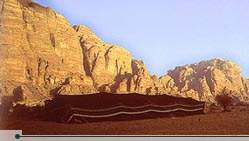
Bedouin tent at Wadi Rum. © Zohrab